February 2026, Issue #18
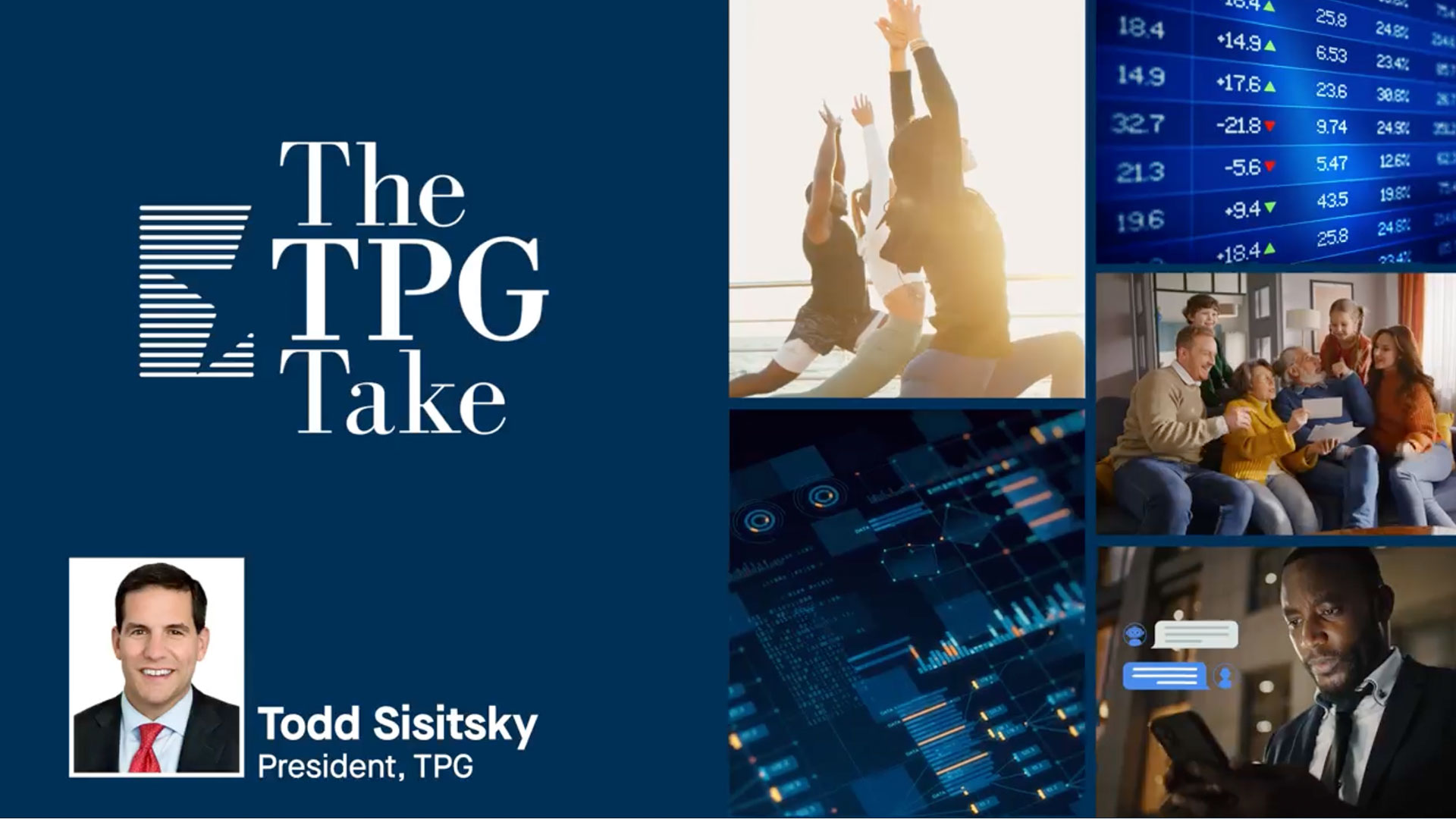
2026 Thematic Observations: A Conversation with TPG President Todd Sisitsky
In our latest edition of The TPG Take, TPG President Todd Sisitsky shares how our thematic investing approach drives differentiated insights and investment opportunities. He explores how we’re investing around three generational trends – wealth, health innovation, and the cascading impacts of AI across industries.
Note: the below is an edited transcript of an interview with Todd Sisitsky. For more, please be sure to watch the full videos.
Our Thematic Investing Approach
Todd Sisitsky: As thematic investors, we start our work by being students of our sectors. We aim to live in the nuances of those sectors, and we try to resist the tide of momentum, which can lead us to a different, or more nuanced understanding of the themes that we're pursuing. And that divergence between common wisdom can create opportunities that we find attractive, but that others in the market may not be pursuing.
Themes in Focus: Generational Wealth
Todd Sisitsky: Let's start by looking at generational wealth – trying to understand the trends, then unpacking the recent investments that we've made in and around the wealth management space. If you look at the headlines, there is a lot of attention around the future of wealth, in particular, focused on two major themes:
- First, is the tidal wave of wealth that will transfer hands in the coming years. Especially from baby boomers to millennials and Gen Z. The baby boomers are rapidly retiring, and in 2025, reached Peak 65, meaning this is the year in which more Americans are reaching retirement age than have ever before or ever likely will again.
- The second general popular view is that millennials are falling behind financially relative to the generations that preceded them. The common belief is that baby boomers reaching retirement age are really the last generation where it can be taken for granted that they would be better off than the generations that came before them.
While both of these common themes reflect some important truths with respect to major trends in wealth, they also dramatically oversimplify the more nuanced reality of personal wealth, and the trends that will shape the industry in the decades to come.
One of the primary reasons we're so enthusiastic about wealth management is around the wealth that millennials and Gen Z will make for themselves. Millennials are beginning to enter their peak earnings years, and Gen Z is just starting to ramp up. And because these generations have a higher propensity to invest in financial assets such as equities, their wealth is compounding faster and actually represents a greater opportunity for the wealth management industry than some of the generations before them.
To put some numbers behind that, over the next 10 years, these generations are on track to generate over $30 trillion of investible wealth on their own, which is much more than they're going to inherit over that period, and more than 1.5x the amount of investible assets baby boomers created over the last 10 years. So, because of the choices that we see millennials and Gen Z making – and this is quite different than the popular wisdom about those generations – we're actually very confident that the multi-decade-long trend of American wealth creation will continue to accelerate.
And we've built a portfolio that I think is very well-positioned not only to benefit from that trend, but to support thoughtful wealth management for those two generations. This includes:
- Companies that will benefit from increased demand for holistic wealth solutions (Creative Planning and HB Wealth)
- Growing allocations to alternative assets (Cliffwater)
- The continued rise in 401(k) savings plans (Human Interest)
Themes in Focus: Life Expectancy & Health
Todd Sisitsky: The concept of lifespan is an area that we believe is a gap between common wisdom and the metrics and measurements that we find important. As a society, we've always been focused on living longer with continued advances in healthcare and recent headlines suggest the possibility of routine living to 100 or even 150 years. When you look historically, medical science has made extraordinary gains in expanding lifespan over the past 200 years. We've more than doubled the number of years we expect to live since 1850, largely by decreasing childhood mortality. And if we take a look at the much shorter timeframe over the past 30 years, the average lifespan has continued to increase by about 2 years.
Lifespan vs. Healthspan
However, if you look closer, the average years spent in good health during that same 30-year period have actually declined. In fact, it turns out that all of the gains in lifespan were driven by more years in poor health. So, while we're living longer, we're actually less healthy for those extended years. That brings us to the importance of not just focusing on the metric that is most readily measurable – lifespan – but importantly, to also focus on healthspan, which is the average number of years that someone spends in good health. And this informs how we invest in healthcare.
Historically, a good example of the difference between lifespan and healthspan is oncology therapeutics, which accounts for nearly 40% of all late-stage pharma assets. A 2014 study found that among 70 approved oncology drugs, the average increase in overall survival rate was just two months. And further, those incremental months were often spent experiencing a range of side effects. Given the high cost, side effects, and relatively modest survival gains, it's a fair question to consider as to whether the oncology treatments of the time were singularly focused on extending lifespan, and whether they excluded other important objectives and metrics like healthspan.
Now, recent breakthroughs in oncology vaccines, for example, and leveraging the immune power of the body through immunotherapy to fight cancer is creating much more opportunity for step-function breakthrough changes in how cancer is treated. The biopharma industry is focused on preventative breakthroughs rather than very expensive, small steps towards longevity. And this is an area where we're spending a lot of time in our life sciences investing across the healthcare sector. We believe we're bringing a more nuanced approach to improving healthspan, the patient experience, the cost efficiency, and lifespan in all the areas in which we invest.
Themes in Focus: Artificial Intelligence
Todd Sisitsky: If you look objectively at the metrics over the past few years, the only reasonable conclusion is that for all the focus, intensity, and hype around artificial intelligence, almost everyone still underestimated the first order effects of AI. AI-native companies are scaling revenue far faster than any previous business model. Open AI and Anthropic have scaled to $100 million dollars of revenue in less than two years, and more recent AI startups like Lovable are scaling even faster to $100 million in months, rather than years. On the infrastructure side, the Magnificent 7 doubled their annual CapEx spend in a mere two years to over $320 billion in 2025.
These numbers are hard to fathom. So to put that in context, major tech giants have already invested more in the AI boom in just three years than the US spent on the entire interstate highway complex, a project that took four decades to complete and represents the largest infrastructure project in the history of the United States.
At TPG, we are investing both behind AI directly, and through AI-empowered plays like, for example, Lyric, in the healthcare space. Our experience in the space spans about a decade, with early investments in companies like C3 AI, which is one of the grandfathers of modern AI. Through our Rise Fund, we partnered with Google and Intersect Power, and invested in Miratech – both of which are indexed to growth in data centers. And we've announced a partnership with Tata Consultancy Services to rapidly scale India's data center infrastructure.
Investing Behind the First- and Second-Order Impacts of AI
While a simple look at the metrics of AI growth may support a thesis that AI will disrupt everything in a uniform way, we've actually tried to dig a layer deeper and think through the second-order impacts. In reality, tech disruption may not be the tsunami that destroys everything in its path, and, in fact, we've seen several situations where incumbents have effectively adopted this new technology to their benefit.
Across our portfolio at TPG, we're investing both in the first-order impacts of AI, as well as the opportunities tied to second-order effects, which are often more subtle and overlooked, including:
- Human for Longer – the desire for human connectivity and services
- Tech Fatigue – increasing the demand for impactful, in-person experiences
- Incumbents vs. Attacker – incumbents effectively harnessing AI to improve their business models
Our ability to marry an understanding of AI with our decades-long focus studying sectors like healthcare, climate, business services, and software, allows us to develop a much more nuanced view as to how AI will affect the businesses and the themes that we're pursuing, and where we might want to pursue a more disruptive theme or company, or where we feel the incumbents will leverage AI to their benefit.
And again, it's that combination that allows us to develop unique insights as it relates to AI, and how it fits in the context of the work that we do as investors.
Thank you to all of our followers and readers for joining us for another edition of The TPG Take. Please share the newsletter with anyone you think would be interested and we look forward to being back in your inboxes.

TPG
345 California St suite 3300, San Francisco, CA 94104, USA
Important Disclosures
This material is solely for informational purposes and shall not constitute an offer to sell or the solicitation to buy securities. The opinions expressed herein represent the current, good faith personal views of the author(s) at the time of publication, and do not necessarily represent the views of TPG, its affiliates, or any of its investment professionals. The opinions expressed herein are not definitive investment advice and should not be relied on as such. The information presented herein has been developed internally and/or obtained from sources believed to be reliable; however, TPG does not guarantee the accuracy or completeness of such information. We provide links to third party websites only as a convenience and the inclusion of such links does not imply any endorsement, approval, investigation, verification or monitoring by us of any content or information contained within or accessible from the linked sites. If you choose to visit the linked sites you do so at your own risk, and you will be subject to such sites' terms of use and privacy policies, over which TPG has no control. In no event will TPG be responsible for any information or content within the linked sites or your use of the linked sites. Predictions, opinions, and other information contained in this material are subject to change continually and without notice of any kind and may no longer be true after the date indicated. Any forward-looking statements speak only as of the date they are made, and TPG assumes no duty to and does not undertake to update forward-looking statements. Forward-looking statements are subject to numerous assumptions, risks and uncertainties, which change over time. Actual results could differ materially from those anticipated in forward-looking statements.