
July 2026, Issue #21
The Next Horizon: TPG AG’s Outlook on U.S. Real Estate
In our latest issue of The TPG Take, leaders across TPG AG U.S. Real Estate discuss the real estate market following a significant repricing cycle in the U.S. They highlight how moderating valuations, constrained new supply, and improving capital markets conditions are converging to create a disciplined, selective environment for deployment, one that favors investors with deep sector and market expertise.
The conversation spans the platform’s positioning across residential, medical outpatient, industrial, and storage real estate, focusing on the demographic and structural tailwinds underpinning each. The team underscores how TPG AG’s longstanding, locally-driven operating partner network remains central to identifying and executing on opportunities at the asset level.
Note: The below is an edited transcript of the interviews. For more, please watch the full videos.
Strategy Overview and Market Opportunity
Matt Jackson: "We think we're at one of the most attractive entry points that we've seen since the GFC. We have values that are still down 15-20% across sectors, largely driven by interest rates as opposed to fundamental factors, which have remained relatively stable and are recovering. At the same time, replacement costs are up at least 30%."
Reid Liffmann: "We're in the later innings of a reset that really started in 2022 when rates went up pretty significantly. At the time, I think what the industry expected was to see a lot of stress for sales that really hasn't come to pass. That said, there remains plenty of assets that are not adequately capitalized for this rate environment and will need to be worked through either recapitalizations or sales."
Matt: "What we’re seeing now is the ability to buy really high-quality assets at discounted values with improving fundamentals, which is quite similar to what we saw in the 2011-2013 timeframe. The other thing that I think is worth mentioning is over the last 18 to 24 months, financing conditions have really turned a corner, and have gone from being a headwind to a tailwind. And most importantly, we're starting to see positive leverage.
In our view, sector selection is table stakes in today's market. You have to be in the right neighborhoods, but you also have to be able to find the right assets and then execute a value-add business plan on those assets. There are several benefits to having a diversified and flexible approach in today's market environment. First, this K-shaped economy that we're seeing is creating a lot of dispersion, both across sectors, but also within each sector at the asset level. And so, having a flexible approach and the ability to pivot as the cycle evolves is more valuable than ever."
Reid: "This is not an environment where you can just buy the market, where you can't just step in and say, 'I'm a buyer of all multifamily in Southeast' or 'I'm a buyer of all industrial on the West Coast.' You need to find idiosyncratic one-off situations, and those situations bubble up from relationships with local operators, local brokers, local lawyers. That is really key to sourcing opportunities.
Our partners are co-investing side-by-side with us and they're true real estate operators. They know the business from an operator's point of view, and so, they have tremendous capabilities to execute, whether you're talking about leasing, renovation, capital improvements, better management.
Finally, our team has deep real estate operating experience. They like the real estate side of the business, the true operations side, and they bring a lot of knowledge to the table. They know a lot about what makes a successful repositioning of an asset work, with experience around renovation and leasing capital projects. And so, because we have both really strong operating partners locally and executing, and a team that's well-versed in real estate operations and execution, I feel like we are well-positioned to navigate this cycle."
The State of Housing
Matt Lazar: "The fundamental backdrop is that the U.S. is largely undersupplied in housing and has been since the GFC. Most estimates are that the U.S. is over a million units undersupplied. Today's interest rate environment has made home ownership cost prohibitive for many, which has been a tailwind for rental residential.
The challenge in today's market is that you can't just broadly pick a market to invest in. The research has to go well beyond that to the property level, and so, we have been extremely focused on our asset selection, partnering with the best local operators, and those are the properties that we're focused on."
Sector Spotlight: Senior Housing
Frank Virga: "COVID-19 was a big disruptor for senior housing, but now it really feels like the sector is coming back in the limelight. The supply pipeline has really gone down, and the demand profile continues to escalate, which is well-positioned for the fundamental growth in the sector. As it stands today, we're back to prior peak occupancy at a point when supply is still relatively muted and demand is accelerating as we approach the silver tsunami, or the rapid graying of the U.S. population. So, we believe the next couple years will be ripe for investing in the sector."
Chris Oka: "We believe there will be several years of continued rent growth, and the reason for that is because you've had this dynamic over the last 15 years where rents have not really kept up with net-worth from seniors and that has really manifested itself in the form of housing values, which are up ~50% from 2020, or stock market holdings, which are up 80-90% in terms of what the S&P has done since 2020. And both of these really create the means by which seniors can afford senior housing."
Sector Spotlight: Student Housing
Matt Jackson: "Student housing requires quite a bit of discernment. Being a half mile in the wrong direction can mean the difference between having a great asset and a perennial underperformer. So, it really requires discernment, careful individual asset selection, and knowledge of the sector.
Chris: "Student housing is one of the most resilient residential asset classes when you think about the demand. However, the market now is very much a tale of the haves and the have-nots. The haves are the largest, tier one state institutions that are getting the majority of the enrollment, and the have-nots are the smaller, regional schools where you're seeing declining enrollments."
Frank: "The evolution of student housing is going to be deeply tied into AI as many things are. I think what's going to happen is a growing gap between the large state flagships and the secondary institutions within each state due to AI fundamentally changing the workforce. And we believe that the schools that are able to reinvest in their offerings and facilities to best capture how AI is going to change the workforce will be the most appealing to students looking to figure out how to get ahead in a more competitive work environment. And so, we really think that gap will continue to widen."
Outlook for Medical Outpatient
Frank Virga: "The U.S. is fundamentally an aging population, and the older we get, the higher the demand for healthcare. Every day around 11,000 Americans turn 65, and as we get older, we consume more in healthcare. We're spending about 18% of GDP on healthcare – up from around 6% in the 1980s. And healthcare spend has grown for every year in the last 25 years except for one – the onset of COVID-19. So, we're seeing this continually expanding demand for healthcare and the need for the hospitals and the providers to keep up."
Reid Liffmann: "The other thing that's happening with medical is that there's a fundamental restructuring in how healthcare is delivered in the U.S. More and more medical is being pushed out of hospitals into surgery centers or adjacent medical buildings, and so, it is very interesting to own medical office that’s campus-adjacent or on-campus."
Frank: "The sector's always been very stable and relatively low growth, but what we are seeing is that over the last couple years, there's been a rapid escalation in the cost of construction and the requirements for yield for developers. And so, what that's doing, is creating a pretty large gap between replacement cost rents and in-place rents market-wide. And so, even in a sector that's historically been stable and low growth, we're actually seeing occupancy tick up over the last couple of years, and more pricing power as the landlord and the owner of these buildings because there's not enough replacement space being brought into the market.
Medical outpatient is a highly fragmented segment of healthcare. The ownership group can be doctor's groups or health systems, for example. And so, one way we're seeking to invest in this fragmented sector is through aggregation ventures, which is multi-tenant buildings anchored by health systems or market-leading providers that have a deep provider base that have strong fundamentals from an insurance standpoint. Affluent demographics, heavily insured demographics, and trying to aggregate that in a well-diversified portfolio in target geographies."
Regional Dynamics' Impact on Industrial Markets in the U.S.
Scott Glassberg: "As a team, we've done a lot of research on the industrial market in the U.S. We've ranked every market and submarket to identify where we would like to invest. So, with that approach, we've formed programmatic ventures to acquire assets in both the Southeast and the Midwest, which are key fundamental markets for us where we're looking to acquire in the future."
Frank Virga: "From an industrial demand standpoint, Florida really has some unique hallmarks. Number one, as the third largest state in the country, it's been a magnet for population growth through a business-friendly climate, low taxes, good weather, and so that really portends well for industrial and logistics demand. It also has so many unique demand drivers from ports, air, freight, and just general logistics, that there are so many avenues of growth where it's really been a strong performer. And given the land-constrained nature of the state, I suspect it'll be a very strong performer going forward.
We have strong operators throughout the state of Florida, and that's really the lifeblood of our business. They serve as a tremendous sourcing channel and flow of information that allows us to make more informed decisions and stay ahead of a market which is really sought after from an investor standpoint."
Scott: "We are paying a lot of attention to the onshoring megatrend in the U.S. with recent legislative bills. We are seeing continued manufacturing investment in the Midwest, which we think is going to drive great fundamental growth. In addition, the Midwest tends to be a very low supply market, so we think that the Midwest industrial is ripe for rent growth.
- Minneapolis industrial is over 50% manufacturing based, which creates this really sticky tenant base, allowing it to have overall better fundamentals in the market. The market is also below 4% vacancy with less than 50 basis points of new supply. So, we also see that market is ripe for rent growth.
- Chicago is a 1.4 billion square foot industrial market. It's the largest industrial market in the U.S. so you have to pay attention to it. Chicago industrial also has sub 5% vacancy with only 1% of supply under construction, which creates a great environment for future rent growth, and a lot of that supply is already spoken for. Despite some of these great fundamentals, it has typically traded at a discount to some of the coastal growth markets, creating a yield premium for investing there that we find to be very interesting."
Matt Lazar: "The Sun Belt has a lot going for it, including domestic migration patterns over the last few years. People are drawn to the Sun Belt for overall quality of life, affordability, job opportunities, and at the same time, companies are drawn to the Sun Belt because of the pro-business environment and the access to labor.
However, absorption in the Sun Belt has remained exceptionally strong, which gives us conviction that the softness is a temporary supply issue and not a systemic demand issue. It means that in today's market, you have to be very selective on which assets you choose and why."
Continued Growth of IOS and Self-Storage
Matt Lazar: "Industrial Outdoor Storage or IOS are logistics properties where the bulk of the value and the utility to the tenant are actually outside the building. It's an essential part of the supply chain. It's the link between the primary source of goods to the traditional warehousing, and then ultimately delivery to the final customer.
IOS has been one of our most active segments because from a demand perspective, it has a lot of the same tailwinds as traditional industrials, such as e-commerce and reshoring. At the same time, in most markets, it faces shrinking supply.
There's a few trends that we've really noticed in IOS over the last few years. First, having properties in good locations that can serve a very diverse tenant base is critically important. For example, over the last few years, freight has slowed down, but we've seen a meaningful uptick in tenants that are supplying data center construction, whether it's components or heavy equipment. From a supply barrier perspective, this is something that has only accelerated."
Scott Glassberg: "We've been investing in self-storage for over 15 years. We've bought over a billion dollars of product, as well as over a hundred assets. In self-storage, we've typically bought assets from non-institutional owners, implemented dynamic pricing tenant insurance and best management practices in order to drive better margins. Today, the market is very fragmented with over 60% held in non-institutional hands, so we tend to buy assets in very idiosyncratic ways that no two deals tend to look the same.
Self-storage is very unique in that we've seen headline rents go down by almost 1% for three years straight, which is a unique dynamic. But over that time, we've still seen NOI growth. Those headline rates today are really just contest rates and what the tenant is actually paying is getting increased over the life cycle of that tenant. You've seen the overall supply demand shift where a lot of supply delivered is still going through the current market. And so, you're seeing really interesting bases at which we're able to acquire these non-institutional assets.
Self-storage still continues to be a business with great underlying fundamentals. When a tenant moves out, you just broom sweep that unit and it's ready to go to the next tenant. There's no heavy CapEx costs, and margins can be up to 70%. So, while headline rents and occupancies have fallen slightly, you're still able to generate really interesting cash flow."
The Impact of AI on Real Estate Investing
Gabie Sotereanos: "AI is a critical focus for our investment strategy, and we're very lucky to be at the forefront because we invested in building an in-house data science team nearly 10 years ago which helps us stay ahead of the curve.
The way our team has been able to implement AI, for example through the use of our replacement cost dashboard, has been pivotal when underwriting deals because we have the proprietary insights at our fingertips that you're not able to find anywhere else. And we only have this information because we made the investment nearly a decade ago.
It’s table stakes creating efficiency with AI. What we are focused on is using AI not only to become faster, but to become smarter, to find opportunities that other people miss, and to have better conviction in the deals that we move forward with."
ICYMI: Other News & Views from TPG...
As part of Goldman Sachs' Talks at GS series, CEO Jon Winkelried, recently joined Matt McClure, global co-head of Investment Banking, to reflect on his career journey. From his early days as a summer analyst to serving as Goldman Sachs' co-president and co-COO, Jon discusses the pivotal moments that shaped the firm across decades, as well as his role in TPG's IPO, strategic expansion, and approach to navigating the AI landscape.
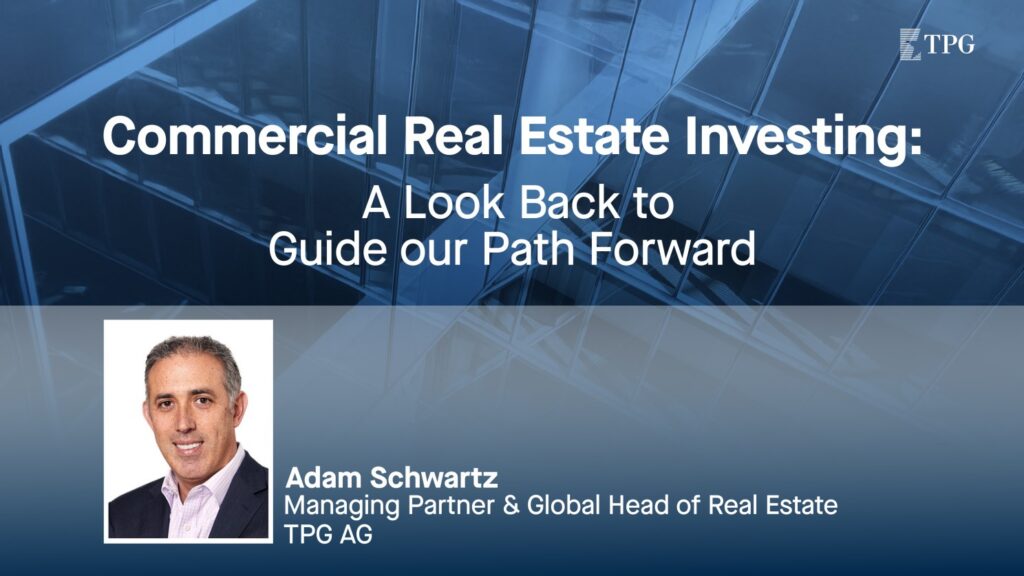
As part of our Investment Insights series, TPG AG Managing Partner and Global Head of Real Estate, Adam Schwartz, takes us through a history of market cycles, how they have shaped today's investment landscape, and why the strongest opportunities still come from proactive value creation, instead of waiting for it.
Thank you to all of our followers and readers for joining us for another edition of The TPG Take. Please share the newsletter with anyone you think would be interested and we look forward to being back in your inboxes.

TPG
345 California St suite 3300, San Francisco, CA 94104, USA
Important Disclosures
This material is solely for informational purposes and shall not constitute an offer to sell or the solicitation to buy securities. The opinions expressed herein represent the current, good faith personal views of the author(s) at the time of publication, and do not necessarily represent the views of TPG, its affiliates, or any of its investment professionals. The opinions expressed herein are not definitive investment advice and should not be relied on as such. The information presented herein has been developed internally and/or obtained from sources believed to be reliable; however, TPG does not guarantee the accuracy or completeness of such information. We provide links to third party websites only as a convenience and the inclusion of such links does not imply any endorsement, approval, investigation, verification or monitoring by us of any content or information contained within or accessible from the linked sites. If you choose to visit the linked sites you do so at your own risk, and you will be subject to such sites' terms of use and privacy policies, over which TPG has no control. In no event will TPG be responsible for any information or content within the linked sites or your use of the linked sites. Predictions, opinions, and other information contained in this material are subject to change continually and without notice of any kind and may no longer be true after the date indicated. Any forward-looking statements speak only as of the date they are made, and TPG assumes no duty to and does not undertake to update forward-looking statements. Forward-looking statements are subject to numerous assumptions, risks and uncertainties, which change over time. Actual results could differ materially from those anticipated in forward-looking statements.