
September 2026, Issue #23
The Reset of the Real Economy: Investing in the Energy Transition
From the energy transition to AI-driven power demand, the forces reshaping the real economy are creating new opportunities across industries. As we kick off #ClimateWeek2026, we’re pleased to share the latest edition of The TPG Take, where leaders across TPG Rise Climate share perspectives on the trends emerging across the climate investing landscape.
Note: The below is an edited transcript of the interviews. For more, please watch the full videos.
The Reset of the Real Economy
Jim Coulter: "At this moment, the investment landscape is changing because we have the convergence of three waves – Decarbonization, Deglobalization, and Electrification. At TPG Rise Climate, we sit in the middle of that convergence. We formed our leadership in the market around decarbonization, but as the other waves have joined, we're well-positioned to express both the reset in the real economy and the necessity of staying on the right side of carbon for the long term."
Decarbonization
Ed Beckley: "The fascinating thing in today's world is that climate investing is not a nice-to-have, it's a must-have. And if we look historically, the energy transition was all about decarbonization; whereas today, it's really about energy security. So, you need to be able to produce your own power to ensure that you have secure and affordable power for everyone."
Marc Mezvinsky: "We are fortunate to have assets that we've created around clean power that satisfy this rising demand. We were behind clean power before it was du jour to have power assets. So we have decarbonization, one; power demand from data centers and AI, two; and three, a real demand pull from corporates as a partner of choice to invest at scale."
Deglobalization
Jonathan Garfinkel: "There are many forces that are happening simultaneously. You have a desire for more and more independence, more deglobalization, and that's after decades of globalization. So from a U.S. perspective, you're seeing companies desire more independence, which leads to job creation and reindustrialization of America. A lot of that, thankfully, when you design from a fresh start, can be done in a sustainable way."
Electrification
Ed Beckley: "We are seeing a re-industrialization in Western economies in the U.S. and in Europe with supply chains coming back domestically, and that's driving a big increase in power demand. And that's happening at the same time that we're seeing electrification. We're seeing a massive increase in power demand from the electrification of transport and of buildings, heating especially. And in addition, we have this data center and AI wave of investment that's going to soak up a lot of power. We see all of those problems as opportunities for us in Climate to invest behind."
The Transition Infrastructure Opportunity: Investing Behind the Physical World
Scott Lebovitz: "The infrastructure markets over the last several years have exponentially expanded. The market today is well north of a trillion and a half dollars, and it's not just the expansion in terms of size, but also breadth. The old infra world was all about transport, bridges, and tunnels, and what we've started to see now is energy becoming more and more important in infrastructure investing, especially as digital becomes more important.
They were very separate for a time, but over the last 24 months with AI, infrastructure has really come to the forefront. Things were happening in the background that needed the physical world, but there was a big emphasis on assets that were asset-light, like software. And what we've seen is we've almost hit a wall where AI – the asset-light business – now needs the real asset world. We need to be able to move that power supply, distribute it, and transport it. As a result, I think it's an exciting time to be in the infrastructure markets."
Hear more from the TPG Transition Infrastructure team
Climate Sector Spotlights: Transport
Jonathan Garfinkel: "The transport sector has a number of attributes that make it unique – it's global, it's dirty, and it's very big. It's also growing, particularly from a sustainable next gen technologies perspective, because the technologies around electric cars and batteries are very well-established. Yet how they're being adopted is very different all over the world. If you think about what we've done in EVs and batteries, it's part of why our global footprint is so powerful. In the U.S. today, one in every ten cars being bought is an electric car. In China, it's one in every two, and in Europe it's about one in every four."
Portfolio Case Study: Beta
Jonathan Garfinkel: "Beta Technologies has emerged as one of the leaders in electrified aviation. They are building an aircraft that is a 50-foot wingspan plane, fully electric-powered with both conventional and a vertical takeoff and landing variants.
For short haul aviation, think 250 to 350 miles, electrification is here, and that's very clearly the direction of travel. These aircrafts are cheaper, they're clean, and now it's just a question of certification, which they're making enormous strides with the Federal Aviation Administration (FAA), with Beta leading the way.
The Trump administration has been quite commercial around this. They created the eIPP program, which is designed to accelerate the adoption of electric aviation for short haul flights. And Beta fortunately, has been awarded more of those contracts than any others, which means you're going to see Beta aircrafts in the market flying cargo missions across 20+ states over the next year. That's going to be a major milestone for adoption and to help people see this is a reality."
Climate Sector Spotlights: Power
Ed Beckley: "Globally, we are having a huge problem in power. There is going to be a massive increase in the demand for electricity, driven by de-industrialization, electrification, and by massive spending in AI and data centers. Plus, it's exacerbated at this point in time because we're facing an energy crisis, especially in a number of markets where gas and oil are still required to produce power.
So, that's the macro that we're looking at. Our view as investors is that we want to be part of the solution. We want to be able to provide full solutions to the market as opposed to just participate in small parts of it."
Portfolio Case Study: Intersect & IPX Power
Ed Beckley: "Intersect Power was a scale renewables developer in the U.S. that through getting to know, we realized that we had a very strong alignment around what the business needed to do. It couldn't just develop renewable projects and produce green electrons, it needed to provide green solutions. So, from the very beginning, our approach was always to produce as much high-capacity factor clean power as cheaply as possible.
If you can produce cheap, high-capacity factor green power, there's a number of things you can do with that – you can sell it back into the grid, or as we did with Intersect, you can choose to co-locate the renewable generations with load, and put that generation behind the meter with, for example, a big data center, and then you're providing a wrapped solution for the hyperscaler or the off-taker to get their power in the most affordable and the greenest way possible. We pursued this strategy with Intersect over a number of years and ended up developing some of the largest data center sites in the world."
Jamie Gilbert: "When the AI megatrend really took hold 18-24 months ago, it meant that Intersect was a very natural partner for many of the hyperscalers, but in particular our partners at Google to be a service provider. That service provision model led to an investment, and that investment led to a desire by Google to own the company outright. What I think was a really powerful move from our side was to execute a carve-out of what we now call IPX Power, and we've set that up as a standalone business to continue doing the things that Intersect was doing that may be less relevant to Google and their ambitions."
Steven Mandel: "With regards to the next stage for IPX Power, first and foremost the company currently is building a massive project in California called the Darden Project, a nearly 2.0 gigawatts solar and 4.6 gigawatt hour battery storage project, which is the largest battery storage project in the world. Fast-forward one or two years from now, this company will have more than 6.0 gigawatts operating, speaking for about $500M of EBITDA, and be one of the largest power producers here in the United States. That offers us maximum optionality."
Jim Coulter: "A key differentiator of TPG and TPG Rise Climate is a focus on problem-solving investing, driving returns by solving fundamental problems in the economy in partnership with key players. We were able to create value for Intersect and value for Google, delivering power at scale and speed. We're proud of what we and the team accomplished in Intersect – we identified a problem, we provided a solution, and we did it in partnership, and the results for our investors, and frankly for the world, are immensely positive."
Climate Sector Spotlights: Industrial Solutions
Marc Mezvinsky: "What do we mean when we say 'industrials' for TPG Rise Climate? When you think about reindustrialization, the capital shift from asset-light to asset-heavier, industrials build the components of the grid, build the components of companies like Beta, build the components of filtration systems on engines. Industrials are the muscle built on the backbone of that thematic. So how does that manifest in our portfolio? We have companies like Miratech that are doing aftermarket solutions for backup power and companies like Sabre that are doing transmission lines for the grid. So, when you look at the refactoring in our economy into this industrials thematic, we're believe we're well-positioned."
Joerg Metzner: "One of the big things in industrial is actually the connection to the power sector. And I think that's where we can clearly differentiate ourselves with our other investments in the power space. You often see in industrials is that there is a clear linkage to having access to cheap renewable power, number one. And number two, those ecosystems in the renewable space are often industrial companies who have been existing for a very long time, and the increasing need to become more energy independent in Europe is driving a lot of the investments also in that area."
Portfolio Case Study: SICIT
Joerg Metzner: "SICIT is really a fascinating company. It was built in the 1960s by the owners of tanneries in Northern Italy. Northern Italy is one of the hotspots for leather products in the world with about 10% of global leather production. If you look at the leather production process, a lot of the incoming hides from animals end up as waste products. What they realized was that if you use those waste products and filter out the chemicals, you can actually create something that is very helpful for crops to grow and become more resilient in the field. And SICIT built a business out of it.
SICIT is the leader in the biostimulants market, which is now a $5 billion market. And we're seeing a lot of growth in the market driven by global demand for these products, particularly in Asia and increasing demand in South America. So, as we came into the company, we've helped them internationalize the sales force, building up a local team in South America and Brazil, where we have strong connectivity. And those are just some of the examples of how we've been helping the company scale further."
Climate Sector Spotlights: Services
Jonathan Garfinkel: "A lot of climate investing is grounded in the capital-intensive parts of the economy. You need to remake the capital stock in order to make it cleaner and greener. But traditionally, in sectors that are capital-intensive, the best investments tend to be the picks and shovels that play into the same ecosystem, but do it in a less capital-intensive way. Services businesses are at the top of the list of the types of opportunities you want to pursue in this regard."
Ed Beckley: "The opportunity in services cuts across all of our main end markets of power, transport, and industrials. And we put a box around it simply because these businesses have so much in common, where we see a lot of these opportunities that are more asset-light, that are faster-growing with a greater ability for us to bring the skills and experience from the rest of the TPG platform to bear. We are going to see more and more traditional services companies play a very important part in delivering this energy transition, allowing us to decarbonize over time, but also move to a more energy-secure future."
Portfolio Case Study: Pike
Jonathan Garfinkel: "The shining example of this is the investment that we made at the end of 2025 in Pike Corporation. Pike is a services business servicing electric utilities. So, at a time when the grid needs to be continually maintained, but also adapt to all the load growth coming from data centers, Pike is the company that both maintains the grid and will help construct the extensions and expansions of the grid."
Elizabeth Stone Redding: "Our investment in Pike came on the back of a multi-year thematic effort in the utility services or grid services space, specifically. Our conviction in the macro growth drivers behind utility grid spending was really the reason we were focused on this space.
Adaptation and resilience is a critical piece of the impact pathways and investment thesis for Pike and the broader grid services ecosystem. Our grid is nearing the end of its useful life and is facing the realities of increased stress from more severe weather as a result of the climate change that we're already living with today. Pike's crews every day are working on behalf of their utility customers to repair, maintain, and upgrade the grid, to enhance the resiliency of the grid in today's world of more severe weather."
Y Analytics: Adaptation & Resilience
Maryanne Hancock: "The Y Analytics team is a public benefit organization that sits within TPG, allowing us to work hand-in-hand with the deal teams, and, importantly, with the portfolio companies that operate in countries all over the world.
We partner with the deal teams whenever it is time to look at a thematic or sub-sector in more depth, meaning we can inform the impact equation from the start. For example, adaptation resilience is a key part of the puzzle when we think about climate investing. Unfortunately, we have gone past 1.5 degrees in terms of the amount of warming that the planet has experienced compared to pre-industrial times. This means that we need to stay focused both on mitigation and on adaptation and resilience.
Right now, there are communities all over the world that are experiencing heat at a level that they've never experienced before. That dramatically impacts the economy, workers, and flows of capital from workers back to their home country through remittances. So, it's clear adaptation resilience is here in terms of the need for it, and the interesting thing has been we're now actually seeing quite substantial investable opportunities in the space.
For example, mostly on the resilience side, we see key aspects of grid hardening, and investments in the grid that are absolutely key to the resilience of economies and communities. We have seen from our research that $1.00 invested in preventative maintenance leads to at least $1.10 to $1.60 in saved costs for a utility in terms of its transmission, distribution, and substations. This is a really important way to get ahead of cost to save money, and in addition to that, to have a pretty powerful impact.
The beauty of the work and our decision tools is that the Impact Multiple of Money (IMM) is something that we've had in place with The Rise Funds for over ten years now. And that is the same tool that we use when we think about adaptation resilience that allows us to look at different kinds of pathways like health, economics for a community, or net income gains or losses for individuals. The slight difference is that we're really using research to quantify avoided loss, just like we look at in the mitigation side of avoided emissions. So, it's a slightly different research base, but the beauty is that the core fundamental logic structure of the decision tool is in the impact multiple of money."
ICYMI: Other News & Views from TPG...
In our latest Investment Insights episode, leaders from TPG Transition Infrastructure discuss the themes shaping the future of infrastructure investing. From power and transport to environmental services, the team shares how a disciplined investment approach, operational value creation, and the strength of the broader TPG ecosystem help uncover opportunities across a rapidly evolving landscape.
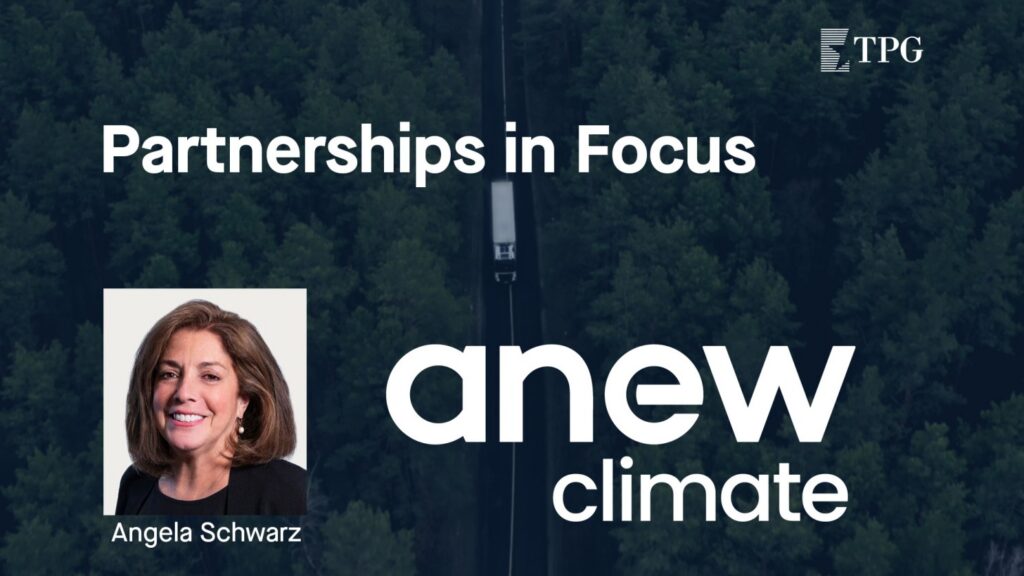
In this edition of Partnerships in Focus, Angela Schwarz, CEO of Anew Climate, shares how the company is helping organizations achieve their strategic objectives while meeting their decarbonization goals. She reflects on Anew’s growth story, the milestones that have shaped the business, and the role the TPG Rise Climate partnership has played in accelerating the company’s vision and impact.
Thank you to all of our followers and readers for joining us for another edition of The TPG Take. Please share the newsletter with anyone you think would be interested and we look forward to being back in your inboxes.

TPG
345 California St suite 3300, San Francisco, CA 94104, USA
Important Disclosures
This material is solely for informational purposes and shall not constitute an offer to sell or the solicitation to buy securities. The opinions expressed herein represent the current, good faith personal views of the author(s) at the time of publication, and do not necessarily represent the views of TPG, its affiliates, or any of its investment professionals. The opinions expressed herein are not definitive investment advice and should not be relied on as such. The information presented herein has been developed internally and/or obtained from sources believed to be reliable; however, TPG does not guarantee the accuracy or completeness of such information. We provide links to third party websites only as a convenience and the inclusion of such links does not imply any endorsement, approval, investigation, verification or monitoring by us of any content or information contained within or accessible from the linked sites. If you choose to visit the linked sites you do so at your own risk, and you will be subject to such sites' terms of use and privacy policies, over which TPG has no control. In no event will TPG be responsible for any information or content within the linked sites or your use of the linked sites. Predictions, opinions, and other information contained in this material are subject to change continually and without notice of any kind and may no longer be true after the date indicated. Any forward-looking statements speak only as of the date they are made, and TPG assumes no duty to and does not undertake to update forward-looking statements. Forward-looking statements are subject to numerous assumptions, risks and uncertainties, which change over time. Actual results could differ materially from those anticipated in forward-looking statements.