January 2026, Issue #17
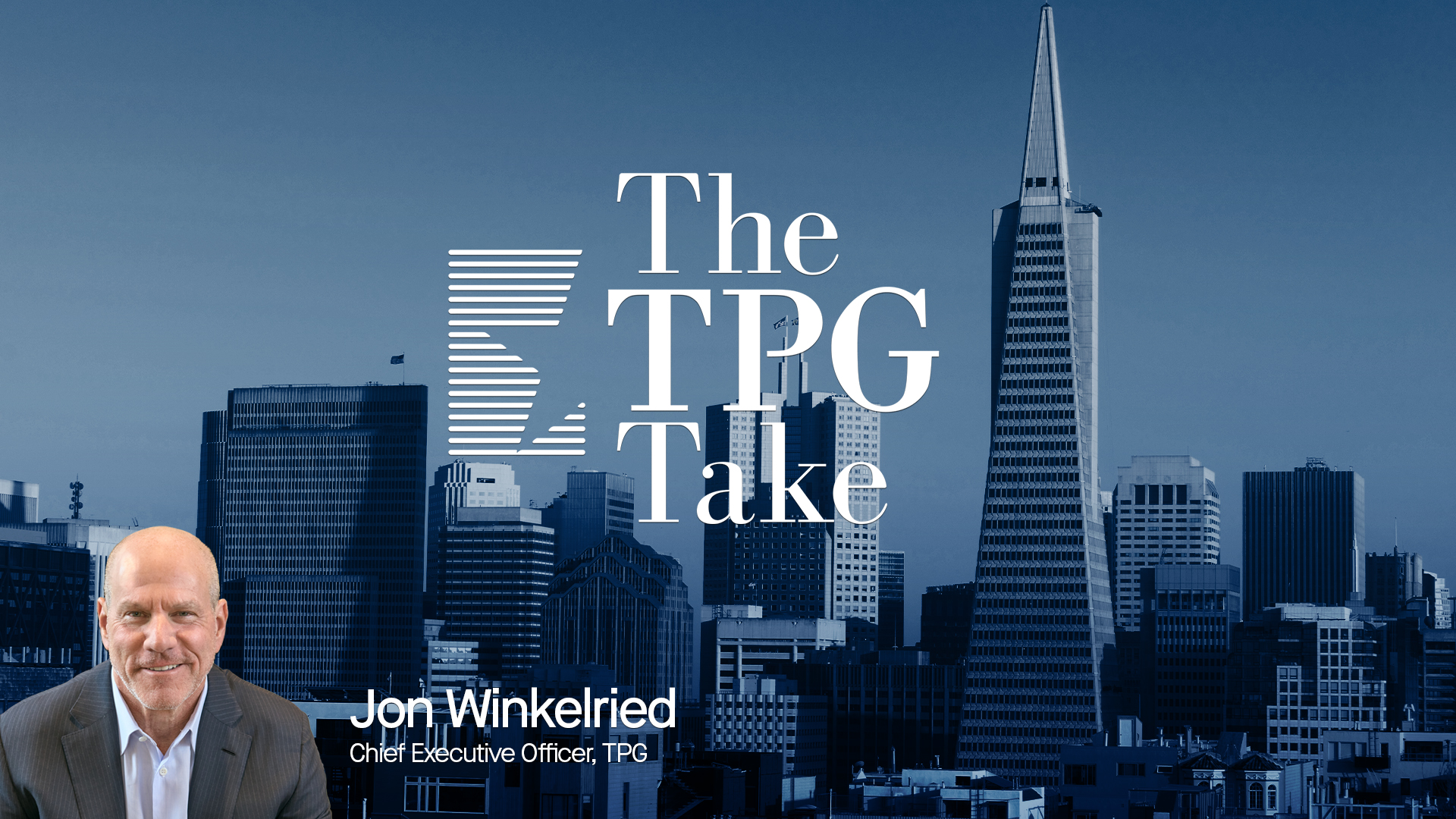
The Year Ahead: Perspectives from TPG CEO Jon Winkelried
As we kick off 2026, in the latest edition of The TPG Take, CEO Jon Winkelried shares his perspectives on the macro landscape for the year ahead, trends he sees shaping the alternatives industry across asset classes, and his thoughts on investing through the AI revolution.
Winkelried also reflects on positioning the firm for continued growth in 2026 and beyond.
Note: the below is an edited transcript of an interview with Jon Winkelried. For more, please be sure to watch the full videos.
2026: The Year Ahead
Jon Winkelried: "2025 has been a year where the markets have gotten used to expecting the unexpected, with the backdrop of a lot of economic cross-currents from policy to interest rates, as well as this tidal wave of AI. In addition to other rising challenges such as geopolitical imbalance that has affected large institutional LPs’ orientation around where and how they want to commit capital.
I think there is substantial uncertainty going into 2026, and I think we're going to have to continue to be prepared for dealing with certain challenges that come along the way. Having said that though, it's not so much caution, but a mindset of being prepared to deal with what comes along that may cause bouts of volatility that may require us to adjust.
Despite that backdrop, I'm generally an optimist, particularly as it relates to the US economy and the drivers of growth and innovation. We just have to be prepared to be nimble and be ready to adjust and stay very focused, and I think we'll be able to take advantage of a lot of those opportunities."
What's Next for the Alts Industry?
Part 1: LP Consolidation in Alts
Jon Winkelried: "Our industry has been incredibly dynamic and it has been fascinating to have a seat in the middle of it because there are very few industries that have been transforming with a general tailwind at the same time. And the shape of the industry has fundamentally changed. Breadth of product and capability matters a lot more today, taking a long-term view, and developing relationships with the most impactful CEOs and entrepreneurs – all of that requires some very basic capabilities, which are getting harder to have or to acquire. Those are:
- Global reach
- Capability across multiple asset classes
- Access to large pools of capital
- Brand
- Quality of human capital
All of these capabilities are now required to be able to position yourself to source the most interesting opportunities and then productize or deliver them to those various constituencies in the market. And the number of firms that are able to do that is shrinking."
Part 2: New Business Models for a Changing Landscape
Jon Winkelried: "You're also seeing the models that these various firms are pursuing in terms of how they're going about building and structuring their businesses continue to diverge. You have convergences like insurance and alternative assets, firms that are trying to build bigger balance sheet businesses, and then you have businesses that are trying to continue to grow their capital base and focus on the capabilities of delivering outstanding returns, while maintaining a balance sheet-light model.
One model isn't necessarily right or wrong. I think that there are different risks associated with each, and as we live through these next cycles, whether it's valuation or interest rate cycles, I think that naturally you'll see that the resiliency of these different models will vary."
Part 3: Convergence of Liquid and Alternative Markets
Jon Winkelried: "As we think about servicing some of these large pools of capital, like retail or insurance for instance, one of the things that's becoming more and more important to service those channels is the question of liquidity. What you're starting to see happen is a bit of convergence between private-alternative (less liquid) with public (more liquid). And we're already being asked in certain situations to manage both liquid and illiquid pools of capital to manage that dynamic.
My perspective is it's harder to go from liquid-public to alternative-private. I think it's easier to go from alternative-private to liquid. And the question is, how do firms in our industry continue to evolve to access that capability? You can either build it yourself internally, perform strategic transactions, or some combination of both.
If you ask me what's the next convergence in our world, I think the next convergence is somewhere around this collision between liquid markets and alternative markets. And that's something that we're thinking about in terms of what the future looks like."
The Real Estate Reset
Jon Winkelried: "The real estate markets have never been more interesting. When you look at the disruptive effect that interest rate increases and COVID has had on the real estate markets more broadly, there's been quite a disruption in terms of value.
For the first time in many years, you had financing rates actually invert with cap rates – so you had financing rates above cap rates. As a result, you've had, in some cases, a lot of assets on the real estate side get frozen into places where ultimately people want liquidity. That has generated opportunities which we've been systematically taking advantage of because we've had a fair amount of dry powder, and we've generally not been in a position where we've been saddled with disproportionate office exposure, for instance, that has dragged us down. So, we've been able to be very offensive.
I think that real estate will be one of the more interesting investing opportunities in 2026. Rates are starting to come back down, and in many cases there are some really interesting opportunities that are coming to market for sale that probably wouldn't have been had it not been for the disruption that we've seen. It's also a global phenomenon. And I think that the investing opportunity that we're seeing is going to be a next-generation opportunity for us as a real estate investor."
The Next Chapter for Private Credit
Jon Winkelried: "The credit markets are all about the provision of capital to companies. Where banks used to be the primary providers of capital and liquidity, that's no longer the case. There's been trillions of dollars of capital that have moved into the private credit space. So putting that in perspective, private credit has become a very important part of the infrastructure of the credit markets, happening over a relatively short period of time.
Now, the market is going through, what I think is, a lot of natural growing pains as it matures and evolves. And ultimately, we haven't been through a credit cycle since post-GFC. I don't view there to be anything fundamentally broken in the market. In fact, if you really take a step back and you look at what's happening in the overall credit environment, I think that in many respects what's happened is very positive.
If you look at the pools of capital that are funding the private credit market, generally speaking, you have longer-term locked up capital, which is a good thing when it comes to dealing with credit cycles and distress. As opposed to banks, or depository institutions, that historically have had to deal with mismatches in terms of the funding sources relative to the duration of their assets, or relative to the duration of the loans that banks were making. I think in a lot of respects, risk is more distributed than it's ever been before, which is also a good thing. And again, the liability structure has probably improved overall in the market. So I think the market is here to stay and it will continue to grow.
One thing is undeniable, which is when you look at the yield structure and the return structure in the market, and what's happened to equity valuations relative to where interest rates or private credit returns are, there's been a compression in returns. As a result, there is a ton of interest from both large institutions, as well as the wealth markets in allocating to the credit markets, and that momentum is continuing. But net-net, I think private credit continues to grow as an important part of the market and an important source of capital for companies."
Investing Through the AI Cycle
Jon Winkelried: "The AI phenomenon is one of these seminal periods of time in markets and in innovation. There is some pattern recognition living through these moments:
- First, markets get overheated whether we like it or not. Capital forms really quickly.
- Two is that usually valuation runs way ahead because of the growth expectation.
- Three, valuation generally drags a lot of things up with it.
- And finally, and perhaps most important, is that in almost every one of these cases, the underlying technology – the innovation – is real.
When you look at the amount of capital being spent and the revenue generation that has to come to support a return on that capital, there's no question that some of the capital will have been well spent, and some of the capital will be flushed.
And so, are we in a bubble? I think we are. Will there be a correction? Will there be a change in sentiment at some point? There will be. That doesn't mean the technology is not real and won't have a profound impact on a lot of the things that we think about from an investment, market, and company structure perspective. AI will reshape the landscape of many of the businesses that we focus on, and frankly, our daily lives. It's likely to affect a large portion of companies that operate in the market today, and when we look at our portfolio and consider any new investments, it's part of every conversation.
In terms of operating our own business, it's critical that we pay attention to AI's role in the growth of our firm. That's the mindset that you have to think about with respect to productivity gains and how we can continue to grow and scale our business. The benefit from AI technology will allow us to do things at a much different level of scale from hours and manpower saved, so there’s a scale opportunity for us without a doubt. And from an investing perspective, I do think this is a generational investing opportunity."
Positioning TPG for 2026 and Beyond
Jon Winkelried: "As far as the firm's growth going into 2026 and beyond, one way to think about that is on two different vectors.
First, is where is capital flowing from? One is on the institutional side, where I think we have among the strongest institutional franchises in the world. What I mean by that is our relationship with the largest pools of capital in the world (i.e. sovereign wealth funds, pension funds). And they are continuing to look to do more with fewer GPs, so they're increasingly being much more selective about their partnerships. More and more of the biggest pools of capital are looking to do things with us across our entire franchise, and I'm very confident that's going to continue into 2026.
When you look at the wealth markets, I think there are a limited number of firms that will ultimately be successful in that market because you have to have the size, scale, and breadth to be able to service those markets. That's a place where our reputation for being focused investors and delivering quality returns is paying off.
Second, I think the market has come to appreciate that TPG has demonstrated its ability to grow across two different sources of growth.
- Organic growth – Incubating new strategies and new businesses (which, from my perspective, is very much a developed skill).
- Inorganic growth – The willingness and the ability to make acquisitions. And in the human capital business that we're in, acquiring businesses is not an easy thing to do. I think we have demonstrated to the market that we can do it, and we can do it very successfully.
Our expectation is that we will be driving growth through both of those pathways. Everybody here is very proud of what TPG has done, what we've accomplished, and what we've built together.
But the key for us is providing and creating different opportunities for our partners. We have a unique angle in terms of how we do what we do. We have a unique culture in terms of how we engage with our stakeholders. And I think that has driven our success. We're in an incredibly privileged position and we're going to continue to build on it."
Thank you to all of our followers and readers for joining us for a new edition of The TPG Take as we kick off a new year.
Please share the newsletter with anyone you think would be interested and we look forward to being back in your inboxes soon.

TPG
345 California St suite 3300, San Francisco, CA 94104, USA
Important Disclosures
This material is solely for informational purposes and shall not constitute an offer to sell or the solicitation to buy securities. The opinions expressed herein represent the current, good faith personal views of the author(s) at the time of publication, and do not necessarily represent the views of TPG, its affiliates, or any of its investment professionals. The opinions expressed herein are not definitive investment advice and should not be relied on as such. The information presented herein has been developed internally and/or obtained from sources believed to be reliable; however, TPG does not guarantee the accuracy or completeness of such information. We provide links to third party websites only as a convenience and the inclusion of such links does not imply any endorsement, approval, investigation, verification or monitoring by us of any content or information contained within or accessible from the linked sites. If you choose to visit the linked sites you do so at your own risk, and you will be subject to such sites' terms of use and privacy policies, over which TPG has no control. In no event will TPG be responsible for any information or content within the linked sites or your use of the linked sites. Predictions, opinions, and other information contained in this material are subject to change continually and without notice of any kind and may no longer be true after the date indicated. Any forward-looking statements speak only as of the date they are made, and TPG assumes no duty to and does not undertake to update forward-looking statements. Forward-looking statements are subject to numerous assumptions, risks and uncertainties, which change over time. Actual results could differ materially from those anticipated in forward-looking statements.